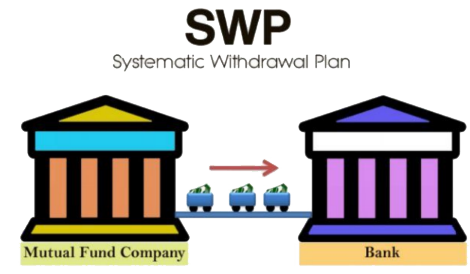
Over the past few years, investors from tier-2 and tier-3 cities have also shown growing interest in creating a regular income stream from their mutual fund holdings. One such strategy gaining traction is the Systematic Withdrawal Plan (SWP) — a method that allows investors to withdraw a fixed amount at regular intervals from their existing mutual fund investments.
Whether you have already created good corpus investing via SIPs or exploring post-retirement income tools, SWPs are emerging as a flexible and transparent way to manage monthly expenses.
📌 What is an SWP in Mutual Funds?
An SWP (Systematic Withdrawal Plan) lets you withdraw a fixed sum — monthly, quarterly, or yearly — from your mutual fund investments. It offers flexibility while helping preserve your remaining capital. Unlike lump sum redemptions, SWP gives you a structured income flow, which is why SWP in mutual funds are being adopted widely by families in India and NRI’s living abroad.
💼 How Does SWP Differ from SIP?
While SIP (Systematic Investment Plan) helps build a corpus by investing regularly, SWP helps you use that corpus to generate periodic income.
SIP
SWP
You put money in
You take money out
Helps accumulate wealth
Helps distribute wealth
Often used in early and mid stages of life
Often used in retirement or after long-term SIPs
Still comparing SIP vs FD ? Many individuals are choosing a systematic investment plan for growth, followed by an SWP for monthly income post-retirement.
🌟 Why Tier-2 Cities Are Adopting SWP More
Increasing awareness through digital platforms
Rise in mutual fund literacy due to mobile apps
Availability of top performing mutual funds
Shift from traditional saving options like FDs
Many investors now compare Fixed deposit vs SIP, then eventually move from SIP to SWP once their financial goals are near.
💡 Best Use Cases for SWP
Post-retirement regular income
Monthly withdrawals for homemakers
Supporting children’s education or rent payments
Creating a side income for freelancers or business owners
SWP calculator is gaining popularity alongside tools like the FD calculator and SIP calculator, making it easy to plan both accumulation and withdrawal phases
📈 SWP from Best Mutual Funds for SIP
If you’ve built your portfolio through investing in the best mutual funds for SIP, it becomes easier to transition to SWP. Investors often begin with:
Best mutual funds to invest for long term goals
Choose the best SIP plans in India
Use tools like SIP calculator to estimate returns
Start SWP mutual funds when the SIP portfolio matures
✅ SIP to SWP: A Long-Term Strategy
Here’s how this full-circle journey looks:
Start investing with a systematic investment plan
Choose schemes from top performing mutual funds , take guidance from an experienced mutual fund distributor
Use SIP returns data to track performance
Once your goal is achieved, switch to SWP for monthly income
Many investors are aware of SIP investment benefits like rupee cost averaging and power of compounding, which help build a sizeable portfolio suitable for SWP withdrawals.
💸 Tax Considerations & SWP
When exploring tax saving investment options, investors often combine SIPs in ELSS funds for tax benefits during accumulation, and later use SWPs for tax-efficient withdrawals.
Keep in mind that taxation depends on holding period and fund category, and you should always consult your mutual fund distributor or relevant sources before initiating.
🧮 Plan Smart: Use Calculators
Before starting:
Try a SIP calculator to plan your SIP journey
Use an FD calculator to compare outcomes
Estimate withdrawal periods and monthly amounts for SWP
Also, get guidance from experienced mutual fund distributor on various aspects of investing and withdrawal from mutual funds.
🏁 Conclusion
The rise of SWP mutual funds in tier-2 and tier-3 cities is a clear sign of evolving investor behavior. As more people shift from traditional options to modern, flexible approaches, the combination of SIP and SWP is fast becoming the preferred lifecycle strategy.
Whether you’re a working professional, a retired senior, or a homemaker looking for stable income — understanding how to invest in mutual funds and how to withdraw smartly can help you get the best of both world